
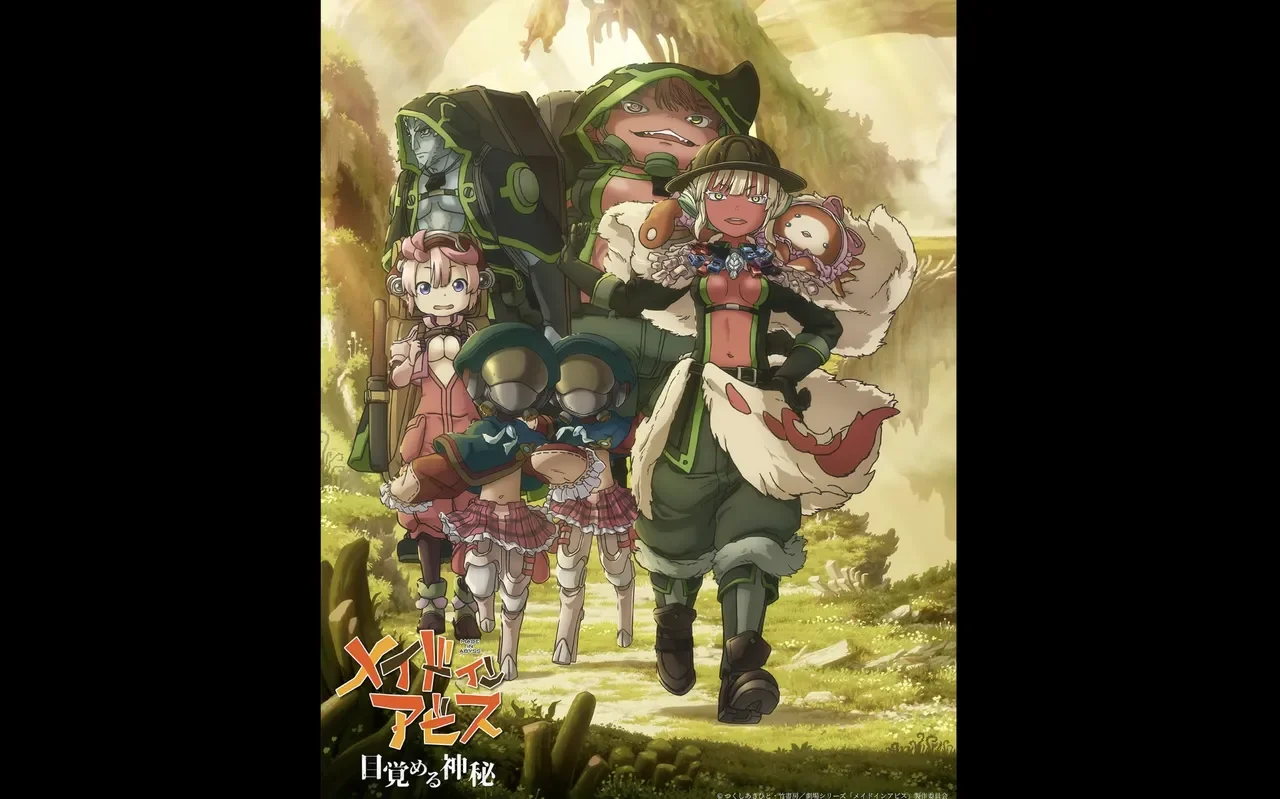
HIDIVE will distribute Made in Abyss: Awakening Mystery in North America and host its premiere on 5 December at Anime Frontier in Fort Worth, Texas. The film opened in Japan on 23 October, continues straight on from the 2022 second season and is the first part of a planned trilogy, with Part 2 already in production.
Premiere and Release Details
Anime Frontier runs from 4 to 6 December at the Fort Worth Convention Center. HIDIVE has placed its screening on the 5th but has not announced a time. A wider release is planned for 2027; some coverage says it will stream on HIDIVE, while other reports note the format has not been confirmed. HIDIVE has also released an English-subtitled trailer.
HIDIVE president John Ledford has advised newcomers to watch the TV series first, and that is sound advice: the story picks up directly after The Golden City of the Scorching Sun. Be aware that the franchise is far darker than its art style suggests. Australia’s Classification Board rated the first season M for mature themes and violence, and parents’ guides flag gore and violence involving children.
Where the Story Stands
Riko is still searching for her mother, the White Whistle Lyza, travelling with Reg, Nanachi and Faputa. The official synopsis calls the seventh layer the Final Maelstrom, the last known layer, and says almost nothing about what lies below.
What the Whistles Really Measure
Delvers are ranked by the deepest layer they have safely reached. Children begin with a Bell, then progress through Red, Blue, Moon and Black Whistles to the White Whistle, which has no depth limit. Red Whistles, for example, are restricted to about 550 metres.
Real-world diving uses similar logic. Recreational certification under the ISO 24801 standard has three levels, with recommended maximum depths of roughly 12 metres for entry-level divers and 20 metres at the next tier. The modern certification model dates to 1952 at the Scripps Institution of Oceanography, introduced after two divers died. In both cases, a badge only records what its holder has survived so far.
A Built-In Survivorship Bias
That is where the Abyss becomes an elegant example of survivorship bias: drawing conclusions only from cases that made it through a filter. Everything the surface knows about the deepest layers comes from White Whistles who returned. Those who did not come back leave no report.
The idea is usually illustrated by statistician Abraham Wald, who worked on estimating aircraft vulnerability from damage on planes that returned during the Second World War. The popular tale of him telling the military exactly where to add armour is largely unsupported, according to the American Mathematical Society, but his central point holds: the missing cases carry the information.
Even the name “Maelstrom” fits. The original, the Moskstraumen off Norway’s Lofoten Islands, is a system of strong tidal currents, reaching around 32 km/h, rather than the bottomless vortex of legend. Edgar Allan Poe’s 1841 story “A Descent into the Maelström” fixed that dramatic image through a survivor’s tale. Legend outgrew the measured reality, much as rumours about the Abyss’s depths travel upward from the few who returned.
Viewers heading into Awakening Mystery may find that lens useful: any claim about the deepest layers is only as reliable as the people who lived to make it.
Comments
No approved comments yet. Join the conversation below.